Sewer line problems rarely announce themselves all at once. They tend to build — a slow drain here, a smell there — until one day you're dealing with a backup in the basement. By that point, what might have been a straightforward repair has turned into an emergency call and a much bigger bill. Knowing what to look for early makes all the difference.
Indianapolis homes built before 1980 are particularly at risk, because many still have original clay or cast iron sewer laterals that are now 40–70 years old. The sewer lateral is the pipe that runs from your home to the city main under the street — it's your responsibility, not the city's. Here are five warning signs Indiana Flow sees again and again, and what they usually mean.
Sign 1 — Multiple Slow Drains Throughout the House
A single slow drain is almost always a localized clog — hair in the bathroom, grease buildup at the kitchen sink. That's a drain repair situation, and usually straightforward. But when multiple drains throughout the house are all running slowly at the same time — the kitchen sink, the bathroom sink, and the shower — that pattern points much further down the pipe.
A partial blockage or restriction in the main sewer line will back pressure up into every fixture connected to it. The three most common causes in Indianapolis are grease buildup accumulated over decades, root intrusion from the city's mature tree canopy, and pipe sag from soil settling beneath the line. A sewer jetter may be enough to clear a soft blockage, but camera inspection is the only way to know whether you're dealing with something structural that will come back.
Sign 2 — Sewage Smell Inside or Outside the Home
A healthy sewer line is a completely sealed system. You should never smell sewer gas in your home or yard under normal conditions. When you do, it means gas is escaping somewhere it shouldn't be.
Inside the house, a sewage smell without an obvious source could be a dry P-trap — an easy fix where you just run water to restore the water seal. But it could also indicate a crack in the sewer line that's allowing hydrogen sulfide gas to enter the living space. That's a more serious problem. Outside in the yard, particularly concentrated in a specific area, a sewage smell is a strong indicator of a crack, joint failure, or root intrusion at that location. Outdoor sewage smells deserve immediate attention. They're often the first detectable sign of a line that's close to a full failure.
Sign 3 — Wet or Unusually Green Patches in the Yard
Sewage makes excellent fertilizer. An unusually lush, green strip of grass — especially one running in a line from the house toward the street — is one of the most classic signs of a leaking sewer lateral. The nutrient-rich wastewater feeds the grass above the leak, creating a noticeable color contrast compared to the surrounding lawn.
A wet or soggy patch in the yard that doesn't correspond to a downspout location and didn't follow recent rain is even more telling. Indianapolis clay soil retains moisture well, which can sometimes mask this symptom. But the grass color contrast tends to give it away in late spring and summer, when the growing season makes the difference visible. If you notice either of these patterns, don't wait for the smell to confirm it.
Sign 4 — Gurgling Sounds from Drains or Toilets
When air becomes trapped in a sewer line due to a partial blockage or a venting problem, it has to go somewhere. It forces its way back through the nearest fixture, and you hear it as a gurgling or bubbling sound — from a floor drain, a toilet, or a shower after you've flushed or run the dishwasher.
The most telling scenario: you flush the toilet upstairs and the shower drain on the same floor gurgles. Or the washing machine drains and a floor drain nearby starts to bubble. These cross-fixture reactions indicate the problem is in the shared main line, not in an isolated branch. A plunger won't fix this one.
Sign 5 — A Sewer Backup in the Basement or Lowest Drain
This one leaves no room for interpretation. When the main sewer line is obstructed, wastewater has nowhere to go but back up through the path of least resistance — the lowest drain in the house. In Indianapolis homes with basements, that's typically a basement floor drain or a ground-floor toilet. If sewage is coming up through these fixtures, stop using water immediately and call a plumber.
A single backup might be cleared with a sewer jetter if the cause is a soft blockage. Recurring backups in an older home are a different matter. When the same drain backs up again within weeks or months of being cleared, that cycle usually means the line has a structural problem — a belly, a collapsed section, or root intrusion so extensive that clearing it only buys time. Camera inspection is the only way to know what you're dealing with.
What Causes Sewer Lines to Fail in Indianapolis?
Several factors make Indianapolis homes particularly prone to sewer line problems:
- ✓Root intrusion.The most common cause in established Indianapolis neighborhoods. Silver maples, oaks, and willows have aggressive root systems that actively seek water — and sewer lines are a prime target. Roots enter through joints and cracks, then expand over years until flow is severely restricted.
- ✓Age and pipe material.Clay tile sewer laterals (common pre-1960s) and cast iron lines (1960s–1980s) have finite lifespans. After 50–70 years, joints loosen, pipe walls thin, and cracks form. Many Indianapolis homeowners are living on borrowed time with original laterals.
- ✓Soil movement.Indiana clay expands when wet and contracts when dry. Freeze-thaw cycles stress buried pipes every winter. A lateral that ran perfectly straight when it was installed may now have a belly — a sag in the middle that traps waste and accelerates buildup.
- ✓Grease and buildup.Decades of kitchen grease, soap residue, and food particles coating the interior walls can reduce the effective diameter of a pipe substantially — even in lines that aren't structurally compromised.
Repair vs. Replacement — When Each Makes Sense
Camera inspection is always the first step, because it determines the scope of the problem. You shouldn't be deciding between repair and replacement based on a guess.
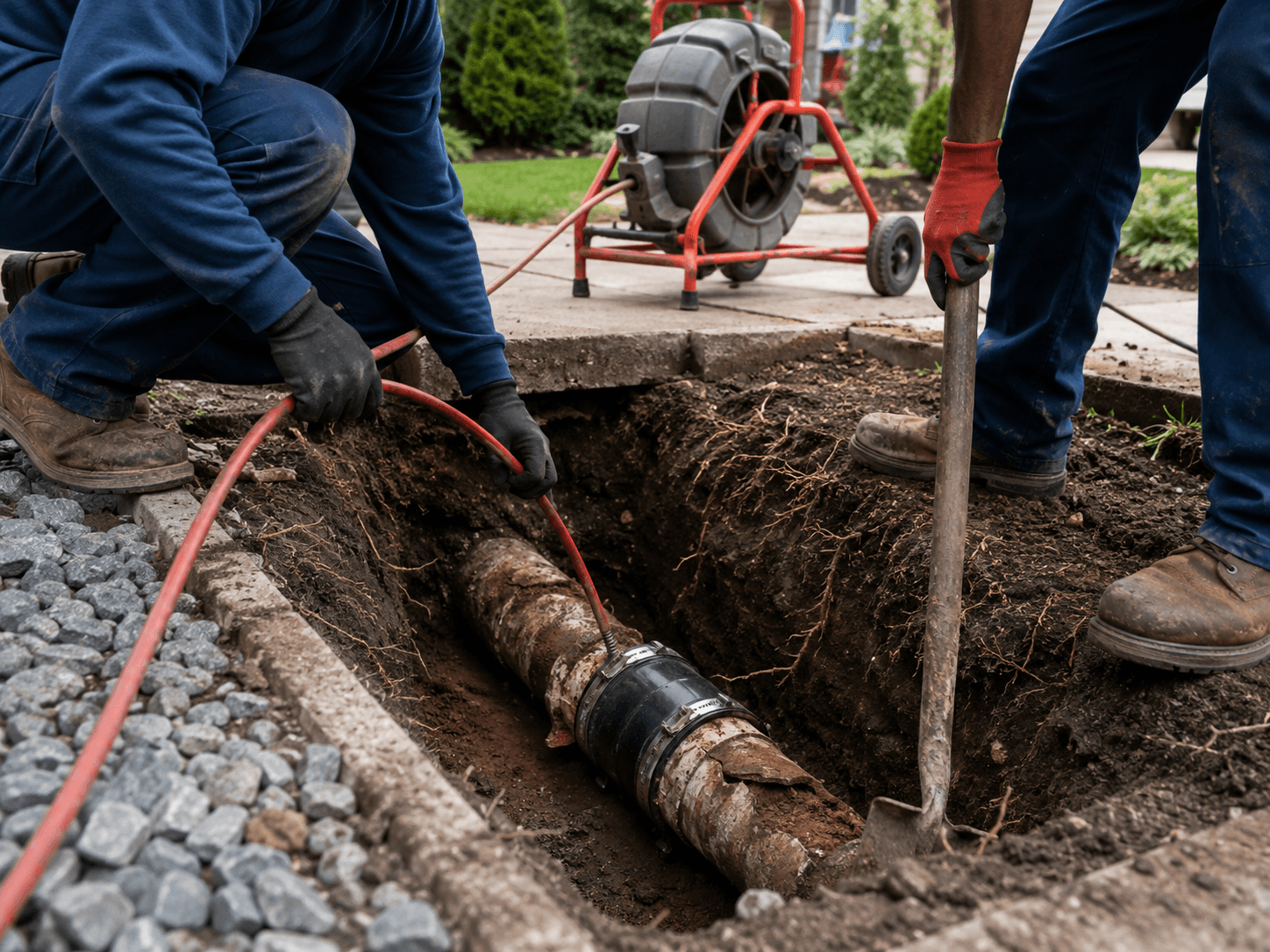
If inspection reveals a localized issue — root intrusion at a single joint, or a small crack in an otherwise sound line — a spot repair or sectional pipe lining may solve the problem without replacing the entire run. These targeted approaches cost less and cause less disruption to your yard.
If the line shows multiple failure points, significant root intrusion throughout, a belly that's causing standing water, or extensive pipe deterioration, full sewer line replacement is the better long-term answer. Patching a line in that condition tends to mean the same call again in a year or two. Indiana Flow doesn't push replacement when a repair will last — but we also won't recommend a patch when the rest of the line is on its way out.
Frequently Asked Questions
How much does sewer line repair cost in Indianapolis?
Costs vary significantly depending on what the camera finds. A sewer jetting service to clear a soft blockage runs a few hundred dollars. A spot repair or sectional lining for a localized issue typically ranges from $500 to $2,500 depending on depth and access. Full sewer line replacement in Indianapolis generally falls between $3,500 and $10,000+, depending on the length of the lateral, pipe depth, and whether trenchless methods can be used. Indiana Flow provides upfront Good/Better/Best estimates before any work begins.
Does homeowner's insurance cover sewer line failure?
Standard homeowner's insurance policies generally do not cover sewer line failure due to age, root intrusion, or wear — these are considered maintenance issues, not sudden accidents. Some policies may cover water damage caused by a backup inside the home if you have a sewer backup rider. Many insurers offer an optional service line coverage endorsement that does cover the lateral itself. Check your policy and ask your agent about adding a rider if you don't have one. Given the age of homes in Indianapolis, it's worth the annual cost.
How long does sewer line replacement take?
Most residential sewer line replacements in Indianapolis take one to two days from start to finish. Trenchless methods (pipe bursting or slip lining) can sometimes be completed in a single day with minimal excavation. Traditional open-cut replacement may require digging a trench along the lateral, which takes a bit longer and requires some yard restoration afterward. Indiana Flow will walk you through what to expect before the job starts so there are no surprises.